Sunday, March 03, 2019

Full course dinner

Not so long ago a full-course meal was a meal with more than 3 dishes. It could be 4, 5, perhaps 7, even 10 or 12. Now it's more like a 21-course meal.
So - what to know about this?

1 course - main dish
2 courses - main dish, dessert
3 courses - starter, main dish, dessert

and after that, it's not so precise - you can choose any dishes you wish to form your courses. It really isn't more specific than that. If you look at 7-course meal suggestions online, you will find many different suggestions for what the courses are.

Here's one, based on adding a course to the previous dinner.

4 courses - hors d'oeuvres, starter, main dish, dessert
5 courses - hors d'oeuvres, starter, fish, main course, dessert
6 courses - hors d'oeuvres, soup, starter, fish, main course, dessert
7 courses - hors d'oeuvres, soup, starter, fish, main course, dessert, coffee
8 courses - hors d'oeuvres, soup, starter, fish, main course, palate cleanser, dessert, coffee
9 courses - hors d'oeuvres, soup, starter, salad, fish, main course, palate cleanser, dessert, coffee
10 courses - hors d'oeuvres, soup, starter, salad, fish, main course, palate cleanser, 2nd main, dessert, coffee
12 courses - hors d'oeuvres, soup, starter, salad, fish, main course, palate cleanser, 2nd main, cheese course, dessert, coffee
18 courses -  hors d'oeuvres, soup, second soup, starter, salad, fish, main course, palate cleanser, 2nd main, 3rd main, vegetables, cold cuts, cheese course, dessert, savory bite, cheese platter, coffee
21 courses - hors d'oeuvres, soup, second soup, starter, eggs, salad, fish, mushroom, main course, palate cleanser, 2nd main, 2. salad, 3. main, vegetables, cold cuts, cheese course, dessert, ice cream, savory bite, cheese platter, coffee

French Classical 17-course meal: hors d'oeuvres, soup, egg dish, grain, fish, main course, palate cleanser, 2nd main, 3rd main, vegetables, salad, cold cuts, dessert, savory bite, cheese platter, fruits and nuts, coffee


1. Starter
the dinner starts with an appetizer, amuse bouche, aperitif, a spicy, small bite
Then comes a thin soup, bouillon, consommé
A thick soup
starter
salad
All these can be put together into one meal.

An amuse-bouche or amuse-gueule doesn't usually count as a dish.

The difference between an appetizer and a starter is... well... there really isn't any. Some people say an appetizer is finger food and a starter is eaten from a plate. If you look at the different meal suggestions, you will notice the simple 3-course meal starts with a starter. That kind of starter is not finger food or spicy small bites. It could be a salad, it could be a soup, it could be an open sandwich, or something else, but it is eaten on a plate by the table.

Fillers

These could be
- an egg dish, like an omelet or souffle
- a cheese dish, like baked camembert or cheese souffle
- a mushroom dish
- grains - pasta or rice dish, or something similar made of other grains, for example, a risotto made of barley (orzotto), soba noodles or blinis (made of buckwheat), injera, grits or polenta, and so on.
- paté, terrine, quenelles, mince, rillettes, mousses, foie grass
- shellfish dish

2. Main dish
a) Fish
followed by a filler or palate cleanser
b) 1. main (Entrée)
cut meat
followed by a filler or palate cleanser 
c) 2. main (Joint)
carved by the table
followed by a filler or palate cleanser
d) whole roasted fowl
followed by a vegetable dish or salad

3. sweet
a) creamy dessert
b) frozen dessert, like ice cream
c) pudding, dessert, cake...
d) fruits

4. savory
a) cold cuts
c) toast
d) cheese platter 

In a 21-course dinner, the sweet and savory are used to fill up the 6 last spots, in a pleasing and satisfactory order.
On the list, I give there's "savory bite", which is usually a toast, to cut the sweetness of the dessert.

5. Coffee 
Usually served with some small sweet morsels, like chocolate bonbons or petit fours, and digestive drink.


The first thing to think about when creating menus is that THIS DINNER CONSISTS OF 21 COURSES, SO KEEP THE PORTIONS TINY. Every course really is just a mouthful, or perhaps two. Keep the starches to a minimum. Ideally, the whole dinner shouldn't have more than 1000 calories. That gives each course about 50 calories.

1. Serve an aperitif before the dinner
Serve the first course together with the aperitif, the hors d'oeuvres
Now, this doesn't really count as a course in the classic dinner menu, but here it does.

2.-5. Now, when the people have been seated, the appetizer, or starter that is going to be served is plated and eaten from the plate with a fork and knife. Don't serve fancy finger food. The appetizer should have a strong taste, but be small.

You can play around a little with the order these starter dishes are served, but the clear soup is served before the thick soup, and the soups shouldn't share ingredients; don't decorate your consommé with vegetables, if you have a vegetable soup as thick soup.
It would also be better if you served the salad between the starter and the fish.

So, practically, you can serve the appetizer as 2nd or 4th course, before or after the soups.
I have put it after the soups because it is very similar to the hors d'oeuvres.

6. Next we have a filler; the egg dish, the mushroom dish, the grain dish, paté or terrine; the shellfish dish
This dish is soft in consistency and taste.
An egg dish is usually either an omelet or a soufflé.
Save one of these after the fish as a palate cleanser. (not the shellfish dish)
Try to follow this logic - don't serve similar ingredients after each other. Don't serve a salad after a vegetable dish, don't serve seafood after seafood, and don't use the same ingredients in dishes following each other.

7.-10. Now, there are basically four different mains on this list; fish, entrée, relevé, and roti.
Fish is always fish and roti a whole roasted bird, but to make some variation with the two dishes in the middle, see that they are different animals. You can choose to serve domestic animal meat and game, for example. (It is also totally fine to serve fish or poultry as one of these dishes. Just see that there are not two meats of the same kind following each other. That is "Fish - Meat - Fish - Fowl" or "Fish - Fowl - Meat - Fowl".

Now, there is another great difference between these two dishes. One is cut meat, and the other is to be carved on the table.

The "cut meat", can be anything, even minced meat. It would be totally fine to serve a Filet Mignon here, Bœuf Bourguignon, cutlets or chops, or even meatballs if you like. This one is to show up the plating and fancy sauces - as said, this is brought to the table plate.

The joint is to be carved on the table, and thus it's not plated. You are to have the potatoes, gravy, and greens to be served with it, and each diner should be able to choose their own here. (It is OK to let the guests serve each other and pass on the platters. See the direction from left to right. The guest who is being served takes first the food they wish to have, and then takes the platter and serve to their right.

In the fin-de-siécle Vienna, the gourmets preferred boiled meat to steak. They ordered their boiled meat weeks beforehand. The steak was for those who didn't know any better. One can add variation to the dinner by serving a boiled dish as one of the mains.

Another piece of meat often ignored is the offal, but a beautifully prepared and served piece of liver is also a very nice meal.

Now, OF COURSE if you are vegetarian, you don't serve meat. There are plenty of vegetarian feast meals that are quite as fine and impressive as whole roasted chicken. Just remember the presentation. Put the vegan loaf in pastry, like in a pie,  or cook it "en croute". Whole roasted rutabaga or cauliflower looks fancier than cauliflower and cheese. Fill a butternut squash or a pumpkin with the vegetables. This IS after all fine dining, so the appearance matters, and it is supposed to be fancy. Now, of course, the taste is still what matters most.

The late Prince Henrik of Denmark was adamant about having 3 vegetables in every dish. But, as this is a 21-course dinner, see that the vegetables are light and portions are tiny.


11.-15. Now, after each "main", there's a vegetable dish, salad, or palate cleanser.
You can choose to serve them as you please, just cut the meat with something between the courses. There should be at least one green salad on the menu, a very simple green salad, basically nothing but some lettuce and vinaigrette.

You can choose to serve the "fillers" at any time during the dinner. Usually, there is one between the starter and the fish and one between the meats and the "finale". 

The cheese course is a dish made with cheese, not the cheese platter, even though nowadays that is what is meant with a cheese course. Examples of cheese courses are cheese soufflé, baked Camembert, and savory cheesecake.
You can replace this with an egg course. Soufflé always works.

16.-20. Then the last part of the dinner; savories and sweets

"Cold cuts" is "buffet froid" - they used to serve things like grilled, cold chicken, aspic, tongue and lobster mayonnaise, paté, terrine, quenelles, mince, rillettes, mousses, foie grass. Meat served cold.
When I was young, there was a chef who specialized in these dishes, and she was usually a woman.

The "savory" is something savory to cut the sweetness of the dessert, so it should be something small, like a cheese toast. You could serve a pasty or pirog of some sort here. Nowadays this dish is replaced with the cheese platter as well.
I have put it after the ice cream because I like to eat something savory after sweet. You do as you please.

I would like to point out that some people think it's very important that the savory dishes are served before the sweet dishes, and the only exception to the rule is the sorbet palate cleanser in the middle of the dinner. This goes for the cheese platter as well. So if you are hosting people like this, be a good host and give them a sweet finish.

"‘It is in a sense monstrous to indulge in a savoury,’ fumed George Augustus Sala in The Thorough Good Cook, ‘the very taste of which must necessarily spoil your appetite for dessert.

How an earth can you enjoy the exquisite flavour of peaches and grapes and pineapples when your tongue has only a minute or two previously been excited by cayenne pepper or curry powder or some other condiment used in confecting these confounded savouries?’"

There can be up to 5 different sweet courses at the end of a many-course dinner.
Fruits and nuts
dessert - entremet de douceur - some sort of pudding, usually baked.
creamed sweet
frozen sweet
ice cream

Now, ice cream and frozen sweets can be the same thing, as it is on my menu, which means, that "ice cream" could be parfait or some other frozen dessert, not ice cream.
On a classic menu "dessert" doesn't mean the dessert, but fruits and nuts.
If you serve two desserts, one should be cold and the other warm.

(I also just read about pre-dessert and post-dessert - a mini dessert before and after the "real thing":-D)

21. After the last pudding, it's coffee with the digestif.
I would serve the cheese platter now because I love cheese and I like to take my time and enjoy the cheeses.
Coffee (or some other beverage) is served off the table, you see, and one can mingle and eat the chocolates, fruits, and nuts or cheeses to one's heart's content, which to me is as it should be.


When you plan a dinner, pick a theme. Try to serve variation.
Unless your theme is "white dinner", don't serve several white dishes.
Unless your theme is "fowl", don't serve several dishes made of fowl.
You get the idea.
Variate ingredients, cooking methods, colors, forms, shapes, sizes.

People are most likely able to taste more than sweet, salty, sour, bitter, and umami, so try to satisfy this.
(They are counting
*sweet and
*salty, which is pretty obvious,
*sour (citrus fruits, soured dairy products, vinegar),
*bitter (dark green leafy vegetables, most cruciferous plants, dark chocolate, grapefruit, most herbs),
*pungent, piquant, spicy, hot (also obvious; peppers, chili, onions, radishes),
*cold [Camphor (camphor laurel, kapur tree, rosemary, camphorweed, African blue basil), Cubebol (Cubeb pepper, basil), Eucalyptol (Eucalyptus, camphor laurel, bay laurel, galangal, ginger), Menthol (mints, peppermint - also catnip, pennyroyal and lavender)]
*astringent or dry (dry wine, black tea, beans, most cruciferous plants, cranberries, walnuts, unripe persimmons),
*umami or savory (MSG, broths and cooked meals, cheese, mushrooms, soy sauce) and
*kokumi or hearty (milk, onions, beer, cheese, braised, slow-cooked meals)

Also, remember that smell and vision influence your taste experience.

Don't overdo it, though. Molecular gastronomy is... boring. It makes eating a gimmick, it makes the gimmick the point, not the food. Dinner should be a social event that is enjoyable because there is lots of good food, satisfying both the taste buds and hunger, a sense of beauty and delight, and leave you happy and content, not stuffed and confounded. Keep it simple.

And that's not all, the more senses you appease to, the better experience the dinner is.
"Is there a rich component, a lean component, a crunchy component, and a cleansing component? Are all the taste sensors activated so that you want to go back for a second bite? Cod works better over a richer preparation like chowder. I would also make sure to choose the right technique for the cod: I would not poach it, because if it is poached it would be silky on silky. If it is seared, it is crunchy on silky—which is more appealing because of the contrast."

—SHARON HAGE, YORK STREET (DALLAS)

------------------------------

I am writing this as a sort of a note for me, preparing a grand Independence Day dinner.

The theme is Finland, of course. The basic idea is to use as many Finnish ingredients as possible and celebrate the typically Finnish flavors and foods.
Finland's Independence Day is the 6th of December, so it's in the winter, and there aren't any fruits around (except apples, dried fruits, preserved fruits... or exotic non-Finnish fruits)

I want it also to be Blue-and-White, like the Finnish flag. There aren't that many blue foods, so it will be mostly white, with some blue, purple, and green inserts.

------------

1. As an aperitif, blueberry mimosa will work well.
 Champagne might do well as well, because, after all, what's a more worthy celebration than independence?

You need 3-5 bite-size appetizers per person. I think 3 is fine because this is a HUGE dinner. 

As an amuse-bouche, I would serve something white, like cheese. Now, don't serve fruits as hors d'oeuvre, because sweetness dulls the tastebuds. It should be something sharp and spicy. Maybe Finnish rye bread crisps with Finnish cheese and something spicy and hot...Chili?
Some sort of deviled eggs might also be nice, with the yolk replaced with something blue and spicy...
I wonder if one could get radishes in the middle of the winter... hmm...

2. Then the soup. First clear consommé, which could be dyed blue with algae, or pea flowers


3. and then a thick soup, for example, cauliflower purée soup. It could also be blue potato soup or red cabbage soup. Red cabbage turns blue when alkaline is added. Spinach and celery are alkaline, but if not enough, add a little baking soda. Not so much that it starts to taste because it doesn't taste good.

4. As a starter I think I'd like a pork terrine.

5. Now, next would be eggs, but I have already served eggs as an appetizer, and I don't want to serve eggs again. I have also served terrine, so it will be risotto. ("barleyotto")

6. Here there will be a little salad, for example, blueberry-spinach salad.

7. The fish course will be Zander Walewska (President Mannerheim's favorite.)

8. Then there will be a mushroom dish. I suggest chanterelles on toast. Now, they are not white, but they are Finnish and delicious.

9.  As the bird I would serve black grouse or capercaille, with some rowanberry jelly, potatoes, and gravy. Beetroot, they say, goes well with grouse.

10. The palate cleanser will be a white currant sorbet.

11. The 2nd main will be Karelian stew with boiled potatoes and traditional Finnish casseroles.

12. The 2nd salad is an apple salad, like Waldorf

13. Then comes the roast, which will be reindeer, served with black salsify and cauliflower

14. As a vegetable dish I think I'll serve a whole roasted rutabaga or celeriac with sauce, barley and creamed kale.

15. Then comes smoked lamb leg

16. Tavastian egg cheese

17. As a dessert, there's only one possibility for me - puff swans on a blue lake

18. as ice cream, vanilla ice cream, pure, clean, and simple. Or maybe tar ice cream, or spruce sprout syrup ice cream, or something else exotic and Finnish :-D

Now, this is butter, not ice cream, but fits as an illustration for my thoughts of plating ice cream :-D
Besides, if I'm planning on serving tar and spruce sprout syrup ice cream, this is kind of the perfect way of serving it... maybe change the herb to a spruce sprout. I think they can be easily frozen and saved for December.

19. Savory bite - traditionally a toast, but I think a piirakka or pasteija would be good here like cabbage slab pie, or karjalanpiirakat.

20. cheese platter

21. coffee avec with mignardise

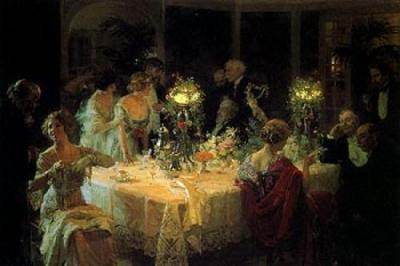
the Youssopovs's 25th Wedding Anniversary 1907

So - how to cook and serve this, then?

1. where, when, and how is this supposed to be served? 21-course dinner isn't for people who cook and serve themselves, but it is doable.

This dinner is supposed to be served at home for the closest family. There are 19 persons in my family, maybe 20. I don't think most of them will come, but let's take 21 courses, 20 people.

The plates and cutlery are the biggest problem.
For my Finnish dinner, one would need 17 plates, 3 bowls, 14 forks, 11 knives, 5 spoons a coffee spoon, and glasses as many as there are wine options, plus the aperitif, and one for water, coffee cup, and a saucer...for each guest.
Now... there is no normal person who has this amount of stuff, but it is possible to hire dishes. You need to know how many dishes you will need to do that and do it in good time beforehand so that you have everything there when you need it.

There is also the possibility of hiring someone to do the dishes while we eat, so there's basically only a need for four sets of plates; two deep and two flat plates - if you place a dish that is eaten from a flat plate between the soups, the soup bowl can be washed while this is eaten on a flat plate, and ready to be used for the next soup.

Something to think about is if you are going to do it à la russe (dishes plated by you), à la anglaise (the guests take food that is being served), or à la française (all the food is on the table and the guests help themselves. The way normal family dinners go.)

The French way would be easiest, but I kind of like the idea of plating the food my way. :-D

If one is to do this alone (or with minimal help), one has to leave the guests to entertain themselves for long moments during the dinner, and the guests might not think this is nice. After all, they are your guests, not guests at your restaurant. Plating by the table might be a solution to this problem. Carving the turkey at Thanksgiving is a show number by itself.

Otherwise one could arrange some distraction in the form of pause entertainment while the dishes are being plated and served. I had thought of creating a video show about the history of Finland with some soft, classical music (we do have quite a lot of that in Finland) during eating, and a short documentary during the time the hostess is absent.

Cook as much as you can beforehand, and do all the cutting and portioning beforehand.
For example, if you plan on cutting vegetables for decoration, do that the day before.
You won't be able to do the soufflé earlier, but you can make the cheese sauce, and egg whites don't suffer from waiting to be whipped for the next day.
You can set the tables beforehand, set the mignardise table beforehand, and bake everything earlier. Most candy and cakes are fine standing on the table overnight, you just need to cover the baked goods with plastic to keep them from drying up. Also, cream-filled goodies need to be in the fridge, and some goodies, like meringue and choux pastry, can't be filled a lot earlier than just before serving so that they won't get soggy.
(Consider all this while planning the dishes! Pick as many "can be made earlier" dishes as you possibly can, where only the minutest amount of assembly is required on the actual day of the dinner party.
Also, consider what can be done with the leftovers. Try to pick dishes that can be frozen for the future, and as little as possible foods that cannot be stored for a long time and have to be thrown away.)

Have a couple of practice rounds before the dinner, so that you know what will go wrong and are prepared for it.

If you need to do everything yourself, you need to streamline it and make it as perfect, effective, and swift as possible.

It is not sensible to make 21 courses for 20 people as "dress rehearsal", but you can test making 20 dishes at the same time, and prepare "freezer meals", something that takes about as long, but that you can freeze as it is and then eat later yourself. It is necessary to test how long time it takes for you to plate 20 meals and how much room you need to do it.

You need to also know how much extra time to prepare the food when it's this much, and how heavy dishes are full of food. How big a kettle do you need to make soup for 20 people?
(Here's a handy list of the amounts of food you need to prepare for each guest - now, remember that with 21 dishes, the portions are at least 1/2 of the ordinary ones, or even 1/4, or less.)

Do you need to measure and bag the spices and herbs needed for each meal so that you know you have enough of everything and don't need to waste time opening and closing spice containers and measuring them?

Now, most of this menu can be prepared beforehand and just warmed up or assembled for this dinner.

To create the timetable:
find out how long time it takes to make and plate every dish,
find out how long time it takes to COMFORTABLY eat the dish, find out when each dish is to be served,
count the first time from the second time and you have your timetable. Yes, it really is that easy.

The difficult part is to make it happen within the time table .-D

To do this, you really need to practice and MEASURE TIME.
Do this with a helper, so that you can focus on plating, and don't need to think about time - the helper will time you.

MY SAMPLE TIMETABLE IS JUST THAT. I BELIEVE IT IS TOO OPTIMISTIC BECAUSE I'M SURE IT TAKES MUCH LONGER THAN 5 MINUTES TO PLATE ANYTHING FOR 20 PEOPLE. It takes time to juggle the plates, food storage boxes, and things in a private home kitchen.

This is why you NEED to practice and check and test everything. You can't expect to be able to function as well as a well-trained professional staff, whether in a modern commercial restaurant or in a Victorian upper-class household. (Unless you are a well-trained professional:-D)


Let's say, it takes 10 minutes to mix the welcome drink and appetizers, 10 minutes to warm the bouillon, and 5 to plate it. The same with the thick soup.
Barleyotto takes 30 minutes to cook and has to be served immediately. It takes 5 minutes to plate.

let's say the guests arrive at 16.00 and are to be served the drinks and appetizers. 15.50 you prepare the drinks and plate the appetizers.

16.15 is time for the thin soup, so after you have prepared the appetizers, you put the thin soup in to warm up, and go serve the appetizers.

When appetizers are eaten, you go to the kitchen, plate the thin soup, and put the thick soup in to warm up, so that at 16.30, when the thin soup has been eaten, you can go to the kitchen and serve the thick soup.

16.45 - pork terrine is served cold, so you can plate it beforehand as well. Now, maybe storing the plates covered with plastic takes longer than actually slicing and plating the terrine and adding the decorations, but that is something you need to test. Anyway, it takes just 5 minutes to get this done, so you can sit by the table and enjoy your barleyotto with the guests.

17.00 is the time for the barleyotto. That takes 30 minutes to cook, so you have to start cooking at 16.30. Now, classic risotto has to be tended all the time, but you can make fine risotto in the oven. So, when you plate the thick soup, you put the barleyotto in the oven, and when you plate the terrine, you check up on the barleyotto.

17.15 a little salad - everything is prepared, it just needs to be plated, and that doesn't take long.

17.30 Zander Walewska - can be prepared beforehand and just gratinated before serving. Put the dish in the oven when you plate the salad.

17.45 Now... chanterelles on toast... you need to toast the bread and cook the chanterelles. That will take about 20 minutes, which means that you basically need to hop over the fish and be in the kitchen cooking the mushroom.

18.00 black grouse with gravy - believe it or not, this too can be done ahead of time, and just popped under the grill for 5 minutes before serving. So, when your toast is ready, put the bird in the oven, eat your toast, and go fetch the bird.
Take the sorbet from the freezer to soften.

18.15 white currant sorbet is done beforehand and takes just minutes to plate.
(Roll it into balls beforehand and refreeze, so that you can just plate the balls. Or form quenelles... looks fancier :-D)

18.30 Karelian stew and side dishes are made beforehand and just need to warm up before serving, so while you plate the sorbet, you put this in to warm up.

18.45 2nd salad is also a quickie.

19.00 whole roasted rutabaga with sidedish might take the longest :-D You cook it beforehand and just grill it before serving. It takes half an hour, so you need to put it in the oven when you serve the Karelian stew. Creamed kale can be made beforehand also, and just warmed up before serving. You can do that when you are finished with your salad. Let your guests have a couple more minutes with it.

19.15 The lamb leg is also served cold, so it's just plating there. But carve it beforehand.

19.30 Tavastian egg cheese needs to be grilled in the oven, and that takes about 15 minutes, so when you plate the lamb, you put the cheese in the oven.

19.45 The puff swans are made beforehand and so is the dessert sauce, so it just needs to be plated.

20.00 Ice cream just needs to be plated, but it needs to soften a little first, so when you serve the swans, you take the ice cream out of the freezer. (Again, make the balls or quenelles, or whichever shape you wish to serve the ice cream in beforehand, and refreeze it. For Finnish Independence Day dinner, it would be wonderful to serve ice cream shaped like a rose.)

20.15 The slab pie needs to be warmed up a little, so when you plate the ice cream, you warm up the pie.

20.30 Cheese has been plattered beforehand, the mignardise is already set out, and the only thing that needs to be done is to make the coffee and tea or whatever else people wish to have.

So - are you OK with the dinner ending at 9 P.M.? If not, you need to move the start of the dinner. As simple as that.

You create a plan with every dish, every plating, and every moment carefully noted so that food is done at the right moment and can be plated quickly and transferred to the table without delay.


Thursday, March 12, 2015

Sacher cake


This is the ORIGINAL Sacher torte as sold at Hotel Sacher.
The cake is pretty dense and dry, it's layered and the cover is hard: it's not ganache. It's actually made by making simple sugar syrup and melting the chocolate in the syrup.
The cake is made without any rising agents, except the egg whites. This Mary Berry gets right.
The apricot preserve is to be warmed, sieved and have a little dark rum added. It works to preserve the cake.
A Sacher can be preserved for two weeks after finishing, because of the apricots and chocolate cover.

The Demel Sacher is baked according to the recipe of the original creator, and it isn't layered.

Mary Berry's Sacher is not a Sacher.
Delia Smith's Sacher is absolutely not a Sacher!

Sacher Cake (Sachertorte)
Viennese Cooking, O. & A. Hess, adapted for American use [Crown Publishing:New York] 1952 (p. 229)

This is the original recipe, obtained through the courtesy of Mrs. Anna Sacher.
 
3/4 cup butter
6 1/2 oz. semi-sweet chocolate
3/4 cup sugar
8 egg yolks
1 cup flour
10 egg whites, stiffly beaten

2 tbls. apricot jam

icing:
1 cup sugar
1/3 cup water
7 oz. semi-sweet chocolate

Beat butter until creamy. Melt chocolate. Add sugar and chocolate to butter; stir. Add egg yolks one at a time. Add flour. Fold in egg whites.
Grease and butter 8-9" cake tin. Pour mixture in.
Bake in 275 degree F. oven about 1 hour. Test with toothpick or straw.
Remove to board; cool.

Cut top off and turn bottom up.
Heat apricot jam slightly and spread over top.

Cover with chocolate icing, prepared as follows:
Cook sugar and water to thin thread.
Melt chocolate in top of double boiler.
Add sugar gradually to chocolate.
Stir constantly until icing coats the spoon.
Pour on top of cake

Note: If desired, split cake into 2 or 3 layers. Fill with apricot jam or whipped cream.

Tuesday, March 06, 2012

Indian and Rye bread from Victorian times


1 tablespoon is 3 teaspoons
1 fluid ounce is 2 tablespoons
1 gill is 4 fluid ounces; 8 tablespoons or 1/2 cup
1 cup is 2 gills or 16 tablespoons
1 pint is 2 cups
1 quart is 2 pints
1 gallon is 4 quarts


The American Pictorial Home Book or Housekeeper's Encyclopedia, by Mrs. Harriet Almaria Baker Suddoth (1883) (pp. 215-216)

INDIAN AND RYE BREAD.

Indian Rye Bread.
—Four pints of corn meal, 4 pints of rye flour, 1 1-2 pints of milk or water, 1-2 tablespoonful of salt, 1 cup of good, fresh yeast.

After sifting the rye flour and meal together add the salt and pour the milk scalding hot on the mixture and stir it very hard until all are well-mixed. If the dough is too stiff, add some warm water, let it stand until it becomes milk-warm, then stir in the yeast. Knead the compound into a stiff dough for 30 minutes, then cover the pan with a thick cloth folded several times, that has been warmed; and set it in a warm place or before the fire to rise; when the dough is quite light and cracked on the top, take it out of the pan and put it on a tray and knead it again for 10 or 15 minutes, divide it into 2 loaves, then set it near the fire cover it, let it remain for 30 minutes. Having the oven ready, put in the loaves immedi­ately and bake 1 1-2 hours. If the dough is sour, sweeten it by adding 1 teaspoonful of soda dissolved in a little hot water.

Indian Wheat Bread can be made in the same manner by using wheat flour instead of rye. A little Indian meal is a great improve­ment to homemade bread, as it keeps it moist and sweet.

Boston Rye and Indian Bread.
—Eight cups each of corn meal and rye flour, 2 cups of good, strong yeast, 1 cup of molasses, 1 dessert spoonful of salt.
After sifting, mix the meal and rye flour with the salt in a large wooden bowl or tray; have ready 1 cup of warm, but not too hot water; mix the molasses and stir in the yeast. Make a hole in the center of the meal, then with a spoon stir in all the flour that surrounds the hole till it forms a thick batter; put the compound in a pan and sprinkle the top with rye meal; place a thick cloth over the pan and set it in a warm place to rise. In 3 or 4 four hours it will be cracked all over the top ; in this case it is light enough ; then open the middle and gradually pour in two cups of warm water; as you pour in, work it till the whole is so mixed as to become a round mass of dough. Then flour hands and work it for 30 minutes until the dough ceases to stick to your hands ; turn it over, then sprinkle it again with rye flour, and again set it in a warm place to rise. Have your oven at a proper heat, so that the bread may be put in as soon as it rises the second time. When light the dough will stand high and the surface cracked all over.
This will do for a medium loaf. Put it directly in the oven and bake it for nearly or quite two hours. The bread will fall if not baked immediately. When done, wrap it directly in a coarse, wet towel and stand it upright till it is cold. It should be baked in a deep iron pan. If the dough should be sour, restore its sweetness by adding a teaspoonful of soda or salaratus dissolved in a little water, then knead it in the dough.
Premium Rye Bread.—One quart each of Indian meal and rye flour and wheat flour, i teaspoonful of yeast, i one of salt. Make a thick batter with warm milk; pour into pans and let it rise. Bake till well done.

Premium Bread
—Take 3 gills each of new milk and boiling water and stir into this flour enough to form a batter; set it by to rise in a warm place ; when sufficiently risen add flour enough to make it thick enough to work with the hands, and for baking. Set to rise in half an hour; then bake in a moderate oven, with a thin piece of paper over it

Superior Bread without Yeast.
—Take cold or ice water, the colder the better, and into this stir coarse corn meal to make a stiff batter; stir quickly, adding the meal, so as to introduce all the air possible. Put it into small patty-pans or cake tins; bake in a very hot oven for half an hour or longer. Baking is the most difficult part of the operation.

Mrs. Gen. R. E. Lee's Bread.
—Take 1 quart of best family flour, put in 1 egg and sweet lard the size of an egg, 2 large table-spoonfuls of yeast (by her recipe), 1 tablespoonful of salt and 1 of sugar.
By this rule bread can be made and the dough kept for 3 days and sufficient taken off to bake for each day. Mrs. Lee says if kept cold in winter or in an ice-house in summer, it will lie dor­mant and may freeze without injury. If frozen hard enough to cut with an ax it will not be damaged, and will rise readily as soon as placed near the fire. If made in this way, to save, and a change of temperature causes it to rise, it must be worked immediately. It is only in this state that it can be injured or become sour.

1) The American Frugal Housewife, by Lydia Maria Child (1832). (pp. 76-77)
―Six quarts of meal will make two good sized loaves of Brown Bread. Some like to have it half Indian meal and half rye meal; others prefer it one third Indian, and two thirds rye. Many mix their brown bread over night; but there is no need of it; and it is more likely to sour, particularly in summer. If you do mix it the night before you bake it, you must not put in more than half the yeast I am about to mention, unless the weather is intensely cold. The meal should be sifted separately. Put the Indian [meal] in your bread-pan, sprinkle a little salt among it, and wet it thoroughly with scalding water. Stir it up while you are scalding it. Be sure and have hot water enough; for Indian [meal] absorbs a great deal of water. When it is cool, pour in your rye; add two gills of lively yeast, and mix it with water as stiff as you can knead it. Let it stand an hour and a half, in a cool place in summer, on the hearth in winter. It should be put into a very hot oven, and baked three or four hours. It is all the better for remaining in the oven over night.


2) The Philosophy of Housekeeping, by Joseph B. Lyman (1869). (pp. 168-170)
―A variety of bread quite common in the Eastern States, and, when well made, surpassed by none for its palatable and nutritive qualities, is a combination of rye meal  and corn meal, called rye-and-indian, or Boston brown bread. For persons of sedentary habits and dyspeptic turn, no food is more wholesome, yet it is by no means easy to produce this article for perfection.
Of unbolted rye meal sift one quart, of unbolted corn meal three pints; to the corn meal add, say, a tablespoonful of salt and half a pint of molasses. Pour upon this, boiling milk or boiling water, till the corn meal is thoroughly scalded. Now add cold sour milk or butter-milk with your rye meal, and soda enough to correct the acid  in the milk and in the molasses. If you have stewed pumpkin or mashed Irish potatoes, a half pint added will improve the flavor of the bread. Mix all the ingredients thoroughly with the hand. It needs no time to rise. Bake in a hot oven for two or three hours. This will make a large loaf; and it is better to put it into one pan than to divide the dough. A very thick and hard, tough, and palatable crust is formed, which some find their teeth strong enough to masticate. A mode of cooking, preferred by some, is by steaming in an ordinary pudding-pan, with a tube running up through the middle, after the manner of a cake-pan. Put the dough into such a dish, cover lightly and place in a kettle of boiling water, where it should remain and boil constantly for four hours. As the water evaporates, supply from a boiling teakettle. Cooked in this way, no crust is formed, and the bread has a delicious flavor, and remains moist for a couple of days.

Wednesday, February 01, 2012

Wednesday, August 24, 2011

Mundus with Morta

24th of August is one of the Roman days of Death, the hole to Underworld was opened this day so that the spirits could visit this world.

Morta was the third of the Roman Fates, the one, who cut the silver cord of life. Don't be afraid of Her, She knows what She is doing, even though you don't. No-one dies before their time. Everyone dies exactly when they are supposed to die. It might seem to us it was too soon, that there was so much to do, so much to achieve, so much to experience, so much life... but there really isn't.
I wish you would learn to know Morta as the kind and gentle sister of Pacithea, Rest. Death is The Big Sleep, the Eternal Rest, where nothing bothers you, nothing harms you, nothing hurts you and nothing pains you.

Have a Silent Party to all your loved ones. Serve their favorite dishes, and set the table for the invisible guests who are passing by your life. All the ancestors who care about you, all your friends and relatives who have gone by, all those who were your soulmates when they were alive... You could also serve a dinner to someone you wish would come and visit you... Who is that? Whom would you like to meet from all the people who are dead today, whom would you serve a dinner? Marie Antoinette? Elvis? C.S.Lewis? Sokrates? Julius Caesar? Mata Hari? Marilyn Monroe?


Wednesday, July 13, 2011

Come Dine With Me

One of my favorite shows on television is Come Dine With Me. What I don't like about it is the belittling, sarcastic and deliberately offensive narrator, and the fact that those who made the show are trying their very best in creating clashes. What that makes, though, is that it makes it impossible to not see what makes a person a good guest/host.

The episodes I like most are the ones where the competitors get well on with each other, enjoy their time, really like the food - and the food is good, well-made and beautiful - and give points generously and there are only a couple of points between first and last.

I like least the episodes with... uh.

The purpose of a dinner party is that people enjoy eating together.
It's not for you to teach new habits, preferences, opinions, information or anything to your guests.
It's not for you to show off.
It's not for you to lecture, it's not for anyone to mock the others or the food, or criticize, or shame or...
Your job is to do your best to make everyone feel good about themselves, you and the food.

I know Come Dine With Me is a competition, but keep your criticism to the point giving.
In what way will telling the host, for example, that the plates are cold change anything? Is he supposed to take the plates back to kitchen and warm them up? No. You are just showing off and making an ass of yourself. The food won't get warm because you point out it's cold. You will also give an unfair edge to the other competitors as you tell them to watch out with the plates - something they might have missed as well, as most people don't warm up the plates for an informal dinner at their homes. So what you have done is caused unnecessary sorrow for the host.

One thing that really irks me with people and food is the terrible intolerance people have. I'm not picky, I know what I like and what I don't like. I don't like seafood. It smells and tastes bad, and the consistence is weird. I have eaten seafood, and I will eat it if I ever has to, but I don't like it.
I don't like onions (onions, leek, chives, garlic etc.) In small amounts, correctly made, in right company, these can be really nice, but 90% of time people use too much, wrong and in everything, so it's better to avoid getting disappointed and having to eat stuff that smells and tastes like rusty nails in sweaty woolen socks.
I don't like mushroom, because they taste dirt.
I don't like asparagus, brussel sprouts, saffron, coriander, coffee and several other things, just like I don't like purple, daisies, ladybugs or Hugh Grant. It's a question of preferences, not that I'd be spoiled, immature and whiny.
It really is not your job to "convert" me. Serving me seafood is just as faux pas as serving meat to a vegetarian.
The worst thing you could do as a host of a dinner party is trying to trick your guests to eat things they have expressed they don't like. I would eat shrimp with aioli and say I like it, because I have manners, not because I liked it.
(P.S. You don't know why people don't like certain foods, and it really is none of your business. Show a little tolerance and respect, and set your guests' comfort before your own.)

Now, there are foods many people don't like. Try to choose food most people will be able to eat.

Food people have generally difficulties with:

offal (liver, tribe) and odd cuts, like pig feet
odd animals, like giraffe
food that looks at you. No whole fish or sheep's head.
raw fish and meat
asparagus, okra, brussel sprouts, peppers, spinach, coriander/cilantro, artichokes, eggplant, beets
garlic and other onions
mushroom
spiced food
strong cheeses, blue cheese, havarti, limburger
peas and beans
seafood, especially oysters and squid, sea urchin, roe...
(anchovies, sardines, kippers...)
seaweed
snails
frogs
ants, grasshoppers, larvae... insects
fermented food, like kimchi/sauerkraut
grits, polenta, semolina, rice pudding, tapioca

There is plenty of delicious food most people have no problems eating, so there is no need to serve any of this.

If your guest asks for something, see that she gets it, if possible. Don't roll your eyes, if your guest wants to "spoil" her dinner with ketchup or horseradish, it's her dinner, and really none of your business.


See that there is salt and pepper on the table, so that your guests can help themselves. Some people like more salty or spicy food than others. It's not an insult, so if you take it as such, you're an idiot.

There should also be plenty of clean, fresh water.

Also see that there are toothpicks on the table, and if you serve anything that is to be eaten with fingers, have bowls of water so that people can wash their hands.

Also, if you are the host, see that your toilet is in pristine condition and there's plenty of toilet paper, soap and towels. The rest of the house doesn't need to be extra super hotel standard clean, but the toilet and the kitchen should be.
See also that there is sanitary napkins visibly (but discreetly) available in case of an accident; and that there are headache pills and something to treat heartburn and upset stomach.

Don't tell people what is the proper way of cooking, serving or eating. It doesn't matter whether you're the host or a dinner guest. It's not your job to educate people of the proper way of doing anything. It's a dinner party, not a finishing school.

Don't say food looks horrible. Keep it for yourself. Most probably the others can see it too, so no need of pointing out the obvious, and if they don't see it, good for them.

Don't criticize the food in any way. If you cannot say anything good, don't say anything. If you're a guest of a competition dinner, you have the points to express your critique, if not, it's rude to criticize a gift. You don't need to eat anything.

Don't make noises or faces, don't "ew" or "yuk", don't roll your eyes, don't grin. 


Don't ever, ever, ever say the food looks, smells or tastes like poo or puke or anything else inedible. Don't even talk about poo, puke or anything else inedible.
Do not talk about disgusting things you have eaten or plan to eat, or have heard someone ate, no discussing placentas, insects, rotten food or baby animals.
Also, no medical details, no mentioning of surgeries, injuries, childbirth or illnesses.
Don't talk about anything that might make anyone feel sick.
No talk about frogs, snakes or snails, even though some people find all these things delicacies.
Just don't. If anyone starts talking about these things, put a stop to it immediately.

If you find the discussion boring, start a non-boring one yourself.

Things to discuss
- what is the best thing you have eaten, what is the best food experience, what was your favorite childhood food, what has been the best dinner experience so far, any restaurants you have visited that left a good memory (or bad)
- Is food a purely taste experience for you, or is it a health or ethical issue?
- What five things you have always in your fridge?
- If you had the opportunity to meet one person you haven’t met who would it be, why and what would you talk about? (And adapted to a dinner situation; which three people; living, dead, fictional, you would invite to a dinner, why and what would you talk about)
- any recommendations about books, movies, tv series
- what is your favorite and least favorite color and why - interesting info; what favorite colors tell about the person
- If you could change one thing about the human body, what would it be?
- If you had a super power / magical ability, what would it be?


If one or more of your fellow guests irritate you, let them. It's a question of just a couple of hours. You can keep your mouth shut for a couple of hours. You can snicker at your smart comments and responses, but don't say them out loud. Lashing out on them will not make them less obnoxious, in the contrary. You have taken the bait, it works. It will only spoil the dinner from others as well, and yours is already ruined, so take one for the other guests.


Dress up nicely. Be clean. Surprisingly people need to be told this.  

If there's a dress code, follow it. It doesn't matter if you think it's stupid or ridiculous or unflattering or something else, it's the host's party and he/she decides.

Bring a gift.
Flowers are good.
Wine is okay, even though some people don't drink it.
Chocolate is okay, even though some people don't eat it.
Other food gifts are okay as hostess gift for a dinner party, for example spiced oil or vinegar, an exciting preserve or cookies.

It is also a nice idea to give party favors. It doesn't need to be expensive or advanced. It's just a gesture. For example, a nice piece of chocolate would be quite proper.

Have some entertainment or party games.

Friday, April 01, 2011

Countdown to Beltane, Day 1

Today is April Fools' Day. It's 30 days to Beltane, the feast of feasts and song and dance and merrymaking and lovemaking...


I am going to post a similar countdown to Beltane as I posted to Ostara, and the same goes as for Ostara countdown; if you leave comments, I'll link to your blog, or if you leave links to an interesting page, I'll link to that.

I appreciate comments, it would be enough to just say ":-)" or "thanks for posting this", if you find it hard to express your thoughts. Just give me a little word to remind me I'm not alone. :-)


I was reminded of the difficulty of reading heavy posts, so I will be sharing the information into three:
in this blog will be all the recipes and meny suggestions,
in Homes4Her will be information relevant to household, living and general holiday information and
in Need More Fiber will be all crafts, daily ornament and such.


Goddess of today is the Trickster Goddess; Loki's mother Laufey, Eris-Discordia, Apate-Fraus, Furrina and Laverna

The trickster God is one of the most misunderstood deities in the world. She is not evil. She is there to remind us of that nothing is fair, we are still animals and everything changes all the time. The world seeks from order to chaos and back again, like a pendulum. She is there to remind us not to take ourselves too seriously. "I'm full of it and know nothing. Dude." Compared to it all, just such a tiny bit of it all as the starry night sky, we are pretty small and insignificant... and yet - the center of the universe ;-)

Eris is considered to be an evil Goddess, interested in creating arguments, quarrels and fights. But... if you think about it... she didn't MAKE people to fight. That is what they CHOSE to do to "solve" the problem they were presented.
"To the most beautiful" stood on the apple she threw among the wedding guests. Naturally the Goddesses were the most beautiful, and they all were equally beautiful, but would they agree on that and let the apple lie?
Would they let it lie because they KNEW it was one of Eris' apples?
Did they agree to give it to the bride of the wedding, Thetis, who was not that much uglier than the Goddesses... and we all know the bride is the most beautiful woman in her own wedding, what ever she looks.
No. They chose to fight over it.
Eris is the Greek Goddess of Strife, Contention, Discord and Rivalry and a Goddess of War.
She is generally understood to be the same Goddess as Enyo (Warsome), who is associated with Bellona and Anatolian Ma (Hebat/Hipta/Kubaba/Kupala/Cybele).

Apate-Fraus, the Goddess of deceit, guile, fraud and lies... interestingly her male counterparts are listed as "cunning wizard God of trickery and disguise" :-Z

Apate and Eris are daughters of Night and Darkness.
(Other children of Night are Sun, Moon and Stars, Dawn, Dusk and Day, Air and Sky,
Doom, Violent Death, Nightmares, Blame, Misery, Faith, Revenge and Avengers and Insolent Pride,
Old Age and Hard Work,
Peaceful Death, Sleep and Dreams,
Moderation, Prudence, Love and Affection.
Pretty basic...)

Laverna is Goddess of Thieves and Furrina... not much is known of this Etruscan Goddess, as the Romans accepted and honored the deities of the conquered people, but didn't know much of them, but one can assume she too was Goddess of Thieves and other nightly activity, and the Goddess of Underworld. I think she might have been the Etruscan Night Mother (Nyx).


Patricia Telesco gives Laufey as the Goddess of April 1st and says
"Spring's upbeat theme continues into April, offsetting the rains with laughter.  It it's been a while since you really chuckled, consider renting a good comedy movie.  As you watch it, light a candle and ask Laufey to join you!"

Here's some information of the positive influence of laughter.
I love Marx brothers' movies and Aristocats. I still laugh when I watch it :-D Part of it is that I'm laughing at myself for laughing :-) It gets me all the time :-)

What's for dinner?
The Fool's Dinner, of course! Serve the desserts first and savoury course last, looking like each other. You could serve "chicken nuggets with peas and carrots and mash" and have a wonderful cake as "dessert". Here some other "switched" recipes and here some ideas for you to try.

You can also eat fish for the April Fish, or eat what ever you want, to honor The Fool and Trickster Goddesses.

Thursday, December 16, 2010

Some side dishes for Yule :-)

Richard Corrigan's Mustard Fruits (Chutney)

250 ml water
400 ml sugar
dash vinegar 100ml
piece of cinnamon
3-4 cloves
peel of one lemon
dried cranberries
50 g dry mustard powder
200 ml mixed peel
400 g dried fruits in small pieces; figs, dates, apricots, pears...

mix all the ingredients in a pot and cook 10 minutes with the lid on.
Spoon the mixture into sterilised jars and seal while hot. Invert the jars until cool. Store in a cool dry place.
Serve Mustard Fruits with ham or cold meats. Refrigerate after opening.

Moroccan orange salad

Peel the oranges. Be careful to get out all the white. Slice the oranges and arrange beautifully on a plate.
Take a pommegranate, cut it half and pound all the seeds on top of the oranges
Sprinkle on some mint or flat-leafed parsley (or arugula) and onion rings, if you like onion.
Make a nice dressing of one part of olive oil, one part of vinegar, orange juice and orange blossom water, and a little sugar, salt and pepper, and sprinkle over the fruits. Dust with a little ground cinnamon.

Waldorf salad is excellent at Yule :-)

Mix some grated horseradish in applesauce :-) Wonderful to ham and roasted bird

Danish red cabbage - also wonderful to pork and poultry

Swedish browned cabbage

Don't only roast potatoes for Yule dinner - roast all kinds of roots, like sweet potato, turnips, rutabagas, swedes, carrots, celery, parsnip, beetroot, even pumpkin and squash goes well :-)
Just peel and cut the vegetables in good chunks, perfect for a mouthful, rub them with oil, salt, a little sugar and herbs, like rosemary and thyme, and roast in the oven for 15-20 minutes, then turn them and roast 15-20 minutes more. Absolutely wonderful :-)

Finnish carrot casserole (kugel)
It's slightly sweet, and in my mind goes wonderfully with meatballs and sausage, but it's too sweet to some people.
Rutabaga casserole
this is the best with pork :-)
Sweet potato casserole
(not sweet potato casserole, but potato casserole that's slightly sweet)
Beetroot casserole

Rosolli - mixed vegetable salad


What to eat with this?

Of course you could eat turkey, duck or goose for Yule, but you should be eating pork. Now, of course the pork should be from a "happy pig". Go and see your Yule ham while it's still alive and see it has a good life.

Delia Smith's Roast Collar of Bacon with Blackened Crackling


Jamie Oliver's Jerk Ham


Nigella Lawson's Coca Cola Ham

Tuesday, September 14, 2010

Gelatinas

This has nothing to do with Goddess and menues. Just desserts I find extremely fascinating.

Where I come from, people don't use much jellies or gelatines.
(Jello is a label and gelatin is pure gelatin, the name of the dessert is with -e; gelatine. Not that it much matters, people use all these words.)
That stuff is almost exclusively used as a thin layer on top of cream cakes or to give shine to fruits. Some amount is used to make puddings, like fridge cheese cake or bavarois and such. In the Latin world this thing is very popular, and so they have invented 100 and 1 different ways to serve and decorate this simple dessert.

If you tilt the serving dish, you get nice patterns :-)

Don't stop with two or three layers... :-D

If you take a special form and fill the cavities with different color jellos, you get nice, almost painted jellos :-)


You can also make different shapes of jellos and bed in clear jello or bavarois


Or cut holes in bavarois and fill with clear fruit jellos, and get nice decoration and taste :-)


Here the "cut holes and fill with jello" is taken to a whole another dimension:
The pistils are made with syringe and the leaves with different items, like spoons and knives and filled with syringe.
here's a video http://www.youtube.com/watch?v=79vhYblqqQk
and I recommend you watch the other videos associated with it :-D
You'll get the idea of how to make petals and leaves
with just a syringe with straight or bent needle.


Not all of this looks nice, but it has a lot of potential...
And think of making a jello layer like this on top of a cake. ;-)

Basic gelatine recipe

Interesing jellies

Vegan gelatin - as gelatin is meat product

Gelatin Tips and Hints

• Use 1 tablespoon or 1/4 ounce unflavored gelatin to 2 cups of water for standard firmness. Decrease or increase water for your particular needs.

• One tablespoon of unflavored powdered gelatin equals 4 sheets of leaf gelatin.

• Other liquids can be used in place of water to prepare gelatin, including juice, wine and cordial.

• Pineapple, raw figs, kiwifruit, guava, ginger root, and papaya contain an enzyme called bromelain which breaks down gelatin causing it to lose its thickening properties. The enzymes are deactivated by cooking, so canned fruits are fine to use.

• Too much sugar can inhibit gelatinization. The more sugar in the recipe, the softer the resultant gelatin will be.

• When using sugar with unflavored gelatin, mix the sugar and gelatin first before dissolving.

• Be sure to drain all solids of their liquid before adding to gelatin to avoid watering down the gelatin.

• For 2 cups of gelatin mixture, allow 1 to 2 cups of solids, either minced, cubed, or cut into small pieces.

• To suspend fruits, meats, or vegetables in gelatin, chill until it is the consistency of cold egg whites. Then mix in the additions and chill until completely set.

• To avoid clumping, dry unflavored gelatin should be mixed with a little cold water first for 3 to 5 minutes to moisten and separate before adding hot water.

• If you are doubling a recipe originally calling for 2 cups of liquid, use only 3-3/4 cups of liquid in the doubled recipe.

• To easily unmold gelatin, spray the mold with cooking oil before filling. If you want to avoid an oily film which might cloud the surface by using oil spray, simply rinse the mold with cold water prior to filling. Or dip the mold into warm (not hot) water to the depth of the gelatin for 5 to 10 seconds, loosen edges with a knife or spatula, and unmold. Return to the refrigerator for 20 minutes to refirm.

• To easily center a mold on a plate, rinse the plate with cold water before unmolding the gelatin.

• Two hours of chilling should be enough for standard clear molds, while it may take up to 4 hours for those with additions. Layered gelatins will take longer, since each layer must be individually chilled and firmed before adding the next layer.

• Gelatin takes twice as long to dissolve when used with cream or milk.

• Firmness varies on the ratio of water to gelatin and temperature. You can successfully melt down (gently using a double-boiler) and re-chill gelatin several times before the mixture loses its thickening ability.

• Do not bring gelatin mixtures to a full boil or you risk losing its thickening properties.

• Keep gelatin dishes refrigerated until ready to serve to maintain their gelatinous state.

• Store gelatin desserts in a covered container to avoid the formation of a thick rubbery skin on the surface.

• Unprepared gelatin has an indefinite shelf-life as long as it is wrapped airtight and stored in a cool, dry place.

P.S. Marshmallows are made with gelatin :-) Here's a vegan marshmallow recipe.

Monday, July 19, 2010

Ashna and kasha knishes :-D

“Lady of Abundance”

Ezina, Eshana, Ashnan - beloved, abundance
is a Sumerian grain Goddess.
"The growing grain, the life of Sumer", "the good bread of the whole world".
He sister Lakhar is the sheep goddess.

She is also the supporter of treaties and laws by withholding abundance from anyone breaking them.


Now when the harvest season for grain gets closer and we are about to celebrate the first harvest, let's look a bit closer at cereals.

* "old world grains", that used to be called "corn" (Goddess of corn isn't necessarily the same thing as Goddess of Maize), especially barley, but also wheat and rye, sometimes even oat.

#1, #2 and #3 - Wheat, corn and rice are the most used grains in the whole world. It varies which one is on top, they are all VERY popular.
#4 is barley, thanks to beer and other alcoholic beverages. Barley is also used as animal food, because it is very easy to grow and very tolerant; it doesn't much care about lack of water, cold or heat.#5 and #6 are sorghum and millet. Many believe them to be the same, but they are not. Millet is one of the oldest grains in the world, and it sustains 1/3 of world population.
# 7 is oats, very much thanks to horses
# 8 is rye, which is very important in Northern Europe. We Finns couldn't live without our rye bread, and as far as I know the Danes and Russians have the same relation to theirs :-D Rye is nutritionally very important. Bread that is made of rye, even refined rye, keeps the eater satisfied longer than wholemeal wheat.
# 9 is Triticale - hybrid of wheat and rye, with similar qualities as rye.
# 10 is fonio, an African grain family
# 11 is teff, another African, mainly Ethiopian grain. Teff is amazing nutritionally and could easily grow everywhere in the world.
# 12 is buckqheat, which is not really a cereal.
# 13 is quinoa, which isn't really a cereal either, but has the same qualities cooking wise :-)

Then there are other grains, that might be interesting to mention:
* wild rice, the wild cousin of white rice
* amaranth, quinoa's and buckwheat's cousin
* kañiwa, quinoa's brother
* spelt, wheat's grandmother
* einkorn - single grain wheat
* emmer - one of the first grains of humankind
* durum - tetraploid wheat (it has four sets of chromosomes instead of the normal two)
* kamut - I love the story of this ancient pre-wheat :-)
* adlay, coix, "Chinese pearl barley", "Job's tears" - a maize relative from Asia. (Funnily enough, they make sort of "coix milk" which they call "Job's tear tea" :-D Reminds me of an old Finnish fairytale of bird milk :-D)

* chia isn't really a grain, it's seeds of a American salvia. It's nevertheless very nutritious, oily and very good food.
* flax seeds are another non-grain food that can be used as grain.

Versagrain is a really good site with all the information one can need

So - everybody loves k'nishes :-)

Kasha knishes

Dough:
2 cups flour
1 teaspoon baking powder
1 teaspoon salt
¼ cup vegetable oil
2 tablespoons ice water
2 eggs; lightly beaten

Filling:
1 egg; lightly beaten
1 cup kasha; whole roasted
1½ cup chicken broth
1 large onion; small dice
5 tablespoons schmaltz
salt & pepper; to taste
3 eggs; lightly beaten

(Kasha is buckwheat groats, schmaltz is chicken fat)

DOUGH FILLING SOURCE: "Love and Knishes" by Sara Kasden 1956

PREHEAT OVEN TO 400 degrees F.
Place the flour, baking powder, and salt in a large bowl; mix well. Make a well in the center and add the oil, ice water, and eggs. Mix with a spoon, incorporating the wet and dry ingredients to make a smooth dough. Turn out onto a board and knead for 2 minutes. Place the dough in a bowl, cover with a damp towel and let stand at room temp. for 30 minutes.
On a lightly floured surface, divide the dough into 4 balls. Slightly flatten each ball to make a disc shape. Divide each disc into 4 equal balls. Cover with a damp towel and let sit at room temp. for 10 to 15 minutes.
Roll each ball out into a circle about 3 1/2 inches in diam. Cover the dough circles with a damp towel until ready to fill.

In a bowl combine 1 beaten egg and the kasha, stirring to coat each grain with the egg. Heat a large non-stick saute pan over high heat. When the pan is hot, add the grain and cook, stirring constantly, over moderate heat for 4 to 5 minutes, or until the kasha kernels are separate and smell nutty. Add the chicken broth and bring to a boil. Reduce the heat and cook, covered, for about 20-25 min. or until liquid has evaporated and the grains are tender but chewy. Cool at room temp.
Meanwhile, saute the onion in the chicken fat over high heat for 15 minutes, stirring frequently, until soft.
Add to the kasha and season with salt and pepper. Add the 3 eggs and mix well.

Place 2 rounded T. filling in center of each circle. Pull the edges up around filling, completely enclosing it and pinching the dough to form a tight package. Turn the packages over, place seam side down on a lightly greased baking sheet, and brush the surface with an egg wash (1 egg beaten with 1 T. water).
Bake for 25 to 30 minutes, or until light golden brown. Serve hot.

SERVES: 8
Kasha and mushroom filling

1 cup onions, diced
1 tablespoon safflower oil
3 cups mushrooms, coarsely chopped
½ cup liquid egg substitute
1 cup Kasha
2 cups vegetable broth
salt & pepper

Saute onions in oil in a large skillet until lightly browned. Add mushrooms & cook until mushrooms are lightly browned. Set aside.
Place egg substitute in a bowl & toss the kasha in it. Place tossed kasha in a large skillet with a tightly fitting cover. Over high heat, flatten, stir & chop the kasha with a fork until the grains separate. Remove from heat.
Bring broth to a boil. Slowly pour broth over the kasha, cover skillet, & cook over low heat until the liquid is all absorbed, about 10 minutes. Remove from heat.
Stir in onion-mushroom mixture, salt & pepper. Cool to room temperature

from "Vegetarian Gourmet" Issue #11

White bean, chard and emmer soup
about farro/emmer...

To dessert I suggest Carnelians of Babylon

Mix 8 ounces of cream cheese so that it's soft. Mix in 4 ounces of finely ground cashews, 2 ounces of raisins, 4 tablespoons of white wine (or lemon juice, or rose water), zest of a lemon and 1/2 cup of powdered sugar.
Sandwich about a tablespoon of this cheese mixture between two dried apricots. It should be enough for about 32 apricots :-)
Sprinkle more powdered sugar on top, if you like.

You can also use almond and cranberry ricotta :-D

This is emmer :-)
Yes... it really HAS that color. Only the hull, though ;-)


Ancient Grains from A to Z: 26 Things to Know
18 Grains and How to Cook Them
Grains of ancient truths